Why There are Diamonds in the Header of this Blog

In the Holy Bible there are numerous accounts of encounters with the Divine. Saul is brought to his knees on the road to Damascus by a “Bright Supernal Light” out of which issues a voice.  Before that Moses encounters a “Burning Bush” likewise out of which issues a voice saying “Tell the People ‘I Am’ sent you”. The writers of the Old Testament share knowledge of encounters with what they deem The Creator and following the ancient tradition of the Rabbinical Jews, eschew ownership of “Him” by not even, generally, pronouncing his name, and, indeed, spelling it in such a way that actually is unspeakable. It has no vowels. This is to make preeminent the station of YHWH as The one great mystery behind, yet immanent, in nature. We are blessed beyond the ability of words to express, the sharing of these experiences by men of old.

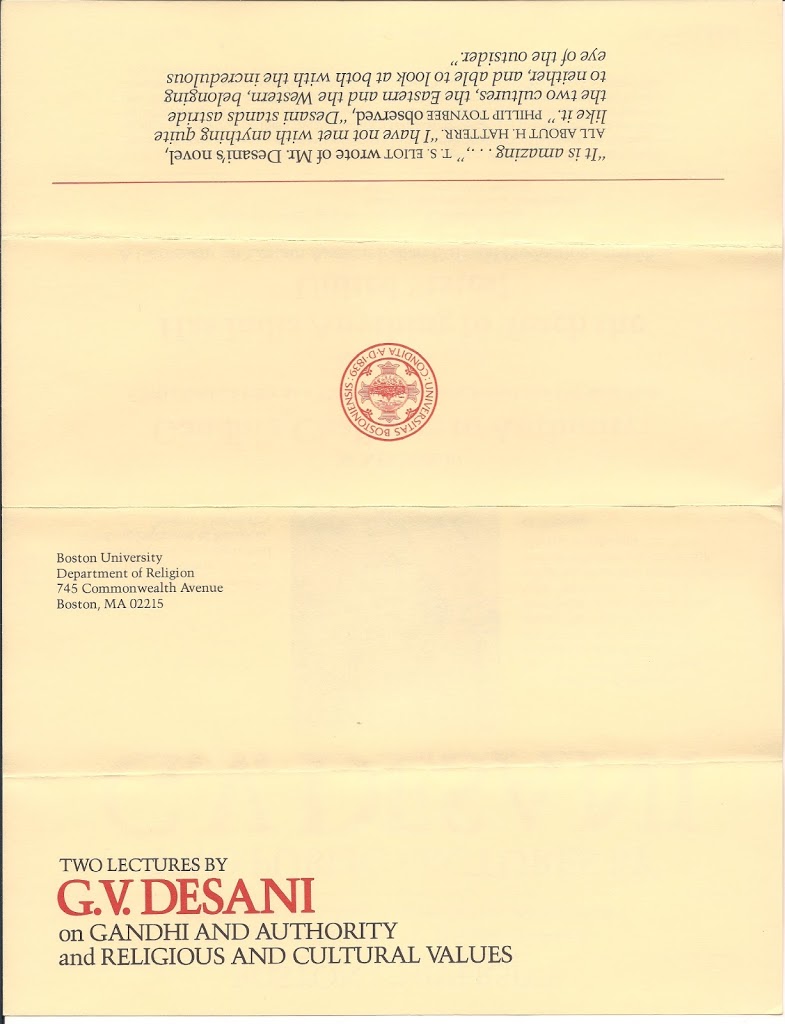
Desani came to us much later and has given us similar, and I think, if not superior, then at least equal experiences, obviously meant, to convey the same wonder and beauty and truth of our being in the world.

I would share these here. Desani lays bare the most intimate secrets of his soul for all to see, his most personal, and private encounters with the object of his intense reverence, devotion, worship, and love, of the great primal spirit. Practiced his entire life this Bhakti yields up to a personal encounter not unlike that of Moses and Saul (Paul) with the Heavenly supernal light in which form G_d eschews some select few a direct encounter with his glory. To my knowledge, in all the world’s great literature there is no more profound sense of the divine than in these passages. In a just and sensible world for these two excerpts alone he should have received the Nobel prize in Literature. They are from his novel Hali:

     The Bell
High up, in the sky, I saw a bell tolling, and with the waves of the solemn sound, the clouds trembled, and the silences between the tolling of the bell filled me with awe and waiting, and those two, the tolling of the bell and the silences between, filled me with echoes such as I had never known, and made me remember sights such as I had never seen, and it seemed to me that it was the will of God that it should be so, and his will that I be content and question no more, and wait by, for his grace to come upon me, as the gentle twilight came upon me at the end of this autumn’s day, as sleep would to soothe an aching heart.
     I waited by the river, and saw the light fall on her, and it was by grace. I looked at the sky, and saw a cloud, and that was by grace. I saw a creature look at me, and I looked upon it with love, and that, too, was a deed by grace. The Majesty is near, and not far, and most near. That faith is a deed by grace. In all things whatever that have beauty, a creature human, too, and in the heart of the diamond and the rose, is grace, and thus have I comfort that I never knew, and knew it now, by grace and grace alone.
     His way is the way to mystery. They that walk on it have no pain. And past all the lights, and all the sights, and all things whatever, the way is to be trodden still, till the soul aches and is lonely from want, in need, and it is then, by grace, she forgets her aches and pains, and is in God, of God, in his grace, and so touched by the Majesty, the crest and the crown of all the worlds, the sword and the sheath of all things, the love in all things whatever, and thus by grace is she healed.
     There is to be no haste and no tears. Ahead is the rain of the petals of the rose, and joy, and rejoicing, that a creature soul never knew, and this remembrance will last till the end of time, for such as have seen and heard, and been in the grace of the Lord, and no remembrance other than this will be, and that would be by grace and grace alone.
A Rose and Lilac Light
A rose and lilac light has passed me by, as might a cloud, and it sailed past from the left to the right of me, and as I turn my head, I still see the trail of fire, a cool rose and lilac fire, as if all the diamonds of the purest rose and lilac were awake, and from their heart came this rose and lilac fire, of such beauty, and the wonder of it has made me lose all yearning, all need whatever, and it has bequeathed upon me a joy as true, as sure, as this rose and lilac light, that passed me by, and this joy is as a treasure entrusted. This day the Lord’s Majesty is in joy, and his joy is reflected in the mirror of the risen Sun, and the Moon to come by, with the early gentle dew, and it is reflected in the calmness of the sea, too, in the still water, in the stars above the sea, in the young snow, and the ice laid upon the farther mountain, and in the heart, too, stilled by a peace, past all yearning whatsoever, all need whatsoever, all wanting whatever, all thirst whatsoever, all hunger whatsoever, and if there are clouds, they sail silently by, and they do not come between me and the Majesty’s joy, and the clouds frame it, never obscuring it, and this joy came upon me as a shower, as a shower of mercy, as love upon the lily on the stalk, and upon the rose, upon the scarlet velvet of the rose, and upon the streams, the brooks, on such that know of this treasure entrusted.
     Once yesterday, whenever such mercy had come upon the earth, it had passed me by, for my heart was of fear, lost, and whenever I saw the Sun setting, with it set the universe, and I was lost, in darkness, and there were but faint lights, lights awed, farther, far, overpowered, so I thought, and it was darkness fathoms deep, that fell upon the earth, and I lost all peace whatever, all love of things whatever, and I was lost in a sea, a sea of darkness, but today, after the trail of light had passed me by, darkness did come hither, but I knew blessedness, heard blessedness, heard the gentlest of sounds, drops of rain falling upon the recent fallen snow, and I heard those sounds sailing through the leaves of the pine, and the poplar, and it was as the song of praises, the praises of Lord God, and thus the darkness passed me by, in peace, in joy, in worship of the worthiest of worship, nowise the erstwhile creature’s night, of pain, fear, the creature that I was, and as the sounds and the song blended, it was a stream, then a river of sound, then a sea of sound, untouched of shore, unheard of by the erstwhile creature, but known and heard this instant, this splendid instant, this august sea of sound, such as is by God bequeathed, from mercy bequeathed, from love bequeathed, by the Will uncaused, and, presently it will bring in its wake the dawn, and it its wake the night, and so will these pass me by, and I shall again see the rose and lilac light, that I saw, not long ago, and it would be another awakening, of the spirit of all the diamonds flashing the purest rose, and the lilac luster, bequeathed, as a treasure entrusted.
     It would again be the awakening of the spirit of the diamonds, such as were asleep, and such as would awake, and the wonder of it will have again given me the peace bequeathed, that I knew not this long past, and the tolling of the bell, and seeing the moon bathing the sea with her lighted silver, the earth too, and the clouds too, precious silver, all with joy abounding, then I, too, will pass by, as did the rose and lilac light, and the trail of it, that did pass me by, knowing blessedness, such as caresses the soul, and the pearls of the sea, and in the midst of this blessedness will God bequeath mercy upon the creatures, and beauty absolute, and peace absolute, even upon such as do not know of such a treasure to me entrusted: and such certain passing makes me want to cry of joy, for today the rose, the lily, the diamond and the dew, and the sea, all things whatever, are content, at peace, as am I, and the mercy of God is come upon us, and all other mercies are become as shadows, as shadows, so happy the rose, so happy the lily, so content the sea, that naught I know, but to sing the praises of God, and to rouse the earth, and the creatures, in one cry, of joy, and with it reach out to the sky, and the star, the cry of triumph absolute, of triumph absolute, and I would brook no delay, and I must sing, and cry of joy unbearing, for this utter grace is come upon me, bequeathed upon me, as a treasure entrusted.


Further thoughts on Further thoughts on Rissala

The last time I broached this subject was in 2013. In 2017 a commenter asked how one might get Rissala into the light of day. In collaboration with friend Todd Katz several emails were exchanged with the inquirer. We hoped he might succeed where we had thus far failed. It rather quickly became obvious our correspondent was not to be such an instrument, though his situation did show some promise. He appeared to have some standing in the literary world, one might say, being that he claimed to be the (an?) author of Desani’s Wikipedia page. Alas, it didn’t pan out. As far as I know he never reached out to the one contact most likely to hold the “key” to Rissala’s whereabouts and, indeed, to Desani’s final wishes as to the disposition of the manuscript.

I’ve tended to come to the conclusion that the right instrument – person – has not come forward  and that for some reason Todd and I are not appropriate or, Desani decided unbeknownst to us that the work would be withheld in spite of evidence to the contrary. He’s allowed to change his mind though for all intents and purposes it’s publication was a driving force in his life during his final years with us.

In Desani’s Nadi Texts written about in this space in 2011 it says that Desani will appear to some people after his passing. I don’t think it was meant in a “dream”. But He has been in my dreams – no surprise there. We dream about all kinds of things. But, two such dreams stand out. In one He was very stern with me….just a disapproving look, as it were. In another, more vivid, he stands alone and gives me one word. “Yield!” Well, the duty of a Bhakta is to do just that. He said so. Yield! And that’s what I’ve tried to do. So, I’m not in contact with that one person who holds the key and the attempt to pass on that effort to another was an obvious mistake and thus a failure.

On this the first full moon of 2018, I Yield.

Desani’s Paper on Civil Disobedience

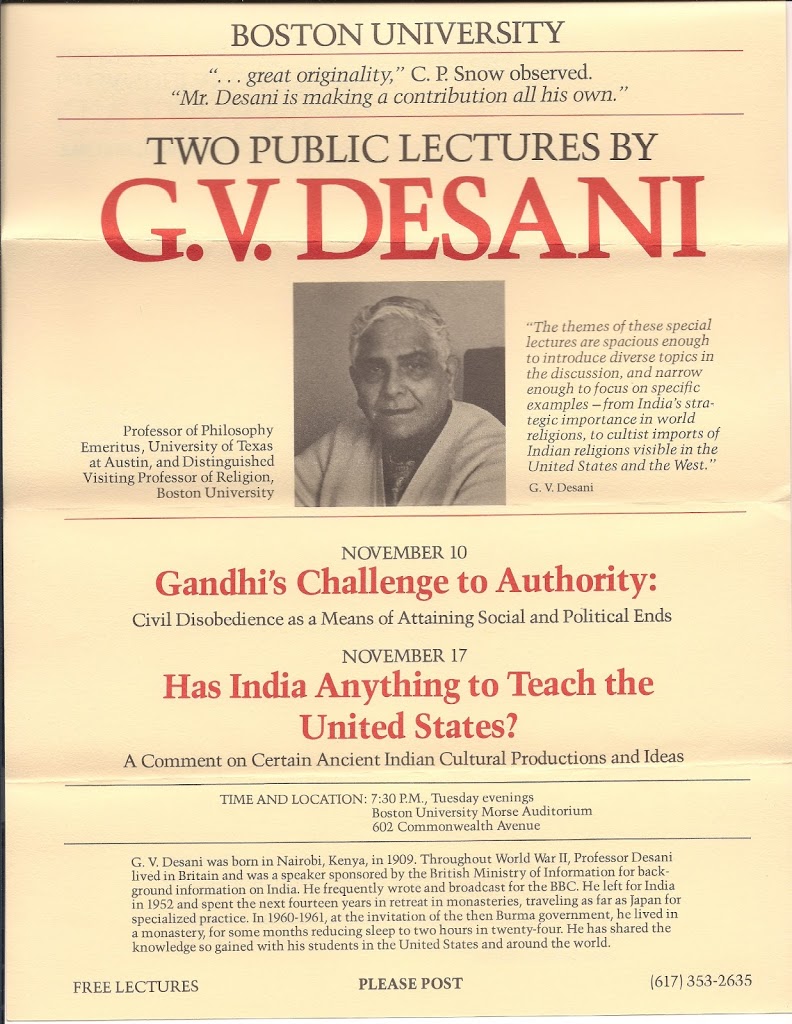
     Todd Katz has today posted a link at http://www.desani.org/other-writings to Desani’s paper on Civil Disobedience delivered at a Colloquium at the Philosophy Department, University of Texas, Austin in 1979. Direct link here. The paper details, from Desani’s unique point of view, Mahatma Ghandi’s political struggles in South Africa and India.

Desani on Pananjali Yoga Sutras

     Heavy Karma is in the mind. Unseen karma consists of innumerable past lives, deeds, words.
 
     The desiring of an object is animalistic. Clinging to an object is equivalent to fear of loosing same. If one tends to animalism one eventually falls into violent experiences, employment, etc. He associates the proliferation of armaments.
 
     A sanskara is an unaccountable karmasaya.
 
     To have a spiritual mentor is a fixed destiny.
 
     Attachment is associated with revulsion.
 
     A selfless action is a virtuous action, duty, without intention, with love, with compassion.
 
     Desani recounts spending a year learning to walk without intention – it is extremely difficult.
 
     Restraints must be imposed on things that are easily overindulged in, e.g., sex.
 
     When Satva rises to its highest level illumination is produced (in a situation).
 
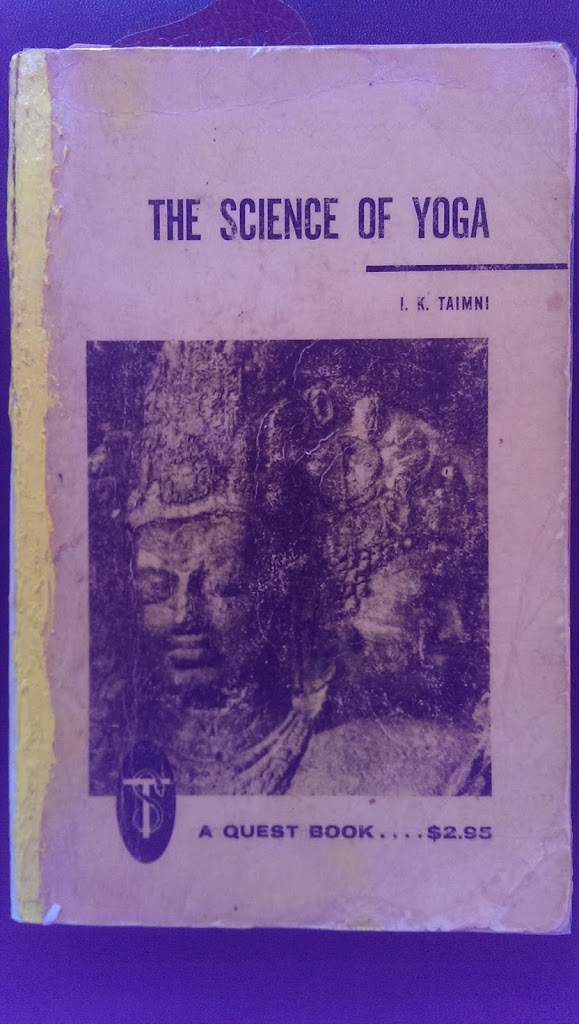
The Science of Yoga
 
     Sutra means aphorism. Yoga is to control the vriti of citta, consciouosness.
 
     The Bhagavad Gita notes there are many yogas. The sage Patanjali’s yoga is a precursor of these.
 
       Raja yoga
       Dhyana/Zen yoga
       Karma yoga – – yoga of action without desire
       Bhakti yoga – – of devotion, like a practicing Christian’s love for his god
       Hatha yoga – – physical yoga
       Kundaline yoga
 
     Samkhya is the theoretical basis of yoga.


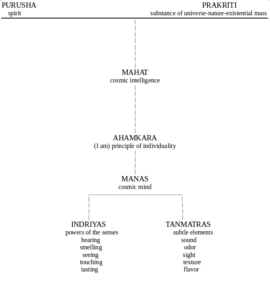
     With reservations there are three elements in Prakriti, the Gunas. They are sattva, rajas, tamas.
 
     The first product of the union of the Purusha and Prakriti is Mahat. It is from Mahat that Patanjali intellectualized his compilation. It is also the Mahat that westerners allude to when they speak of Universal Mind., etc.
 
     Consciousness is made of, consists of, the three Gunas. A rose is made of the Gunas. The image of a rose in one’s mind is made of the Gunas. The difference is, with reservations, a matter of quantity.
 
     a. Satva – The most subtle substance in nature – mental substance. On the moral level it is goodness and on the aesthetic level, the most beautiful.
 
     b. Rajas – Animating element
 
     c. Tamas – Passive element. The tendency to procrastinate is tied in with Tamas. It is the steadying element, pulls toward sleep.
 
     Yoga has to do with the second Guna, Rajas, with stopping the animating element so that Satva can shine forth. This is the quieting of consciousness.
 
     Samadhi grants Mokhti, freedom.
 
     Patanjali’s first sutra is that Yoga is the inhibition of the citta vritis (modifications of the mind).
 
     Five kinds of citta vritis
       1. A person feels full of lethargy, sleepy. a. and b. are conquored by c. He notes that the gods never sleep and recounts that as a monk he went ten or so days without sleep stating that during this time Satva reigns.
       2. A person is full of anger – c. dominates
       3. A person is full of restlessness – b. dominates
       4. A person is full of good works – a. dominates
       5. The highest Samadhi is the one that grants knowledge though it is still a modification of the mind.
 
     So, Purusha, spirit, and Prakriti, cosmic substance are foundational.
 
     Yoga means union (yoke).
 
     The first result of the union (yoking) of spirit and cosmic substance is cosmic intelligence.
 
     He mentions the Nadi Shastras speaking of foreknowledge. Two centuries ago a palm leaf refers to Desani by name, gives date of birth, place, and so forth.
 
     Qualities of Purusha – It is the lord, it is not material, it is conscious.
 
     Qualities of Prakriti –  Satva – mental substance, Raja – activating element, Tama – inertia.
 
     He says that a 2500 year old commentary says that space and time are schemes for the understanding.
 
     In Mahat Satva dominates. Mahat is the source of wisdom. Mahat is the first evolute.
 
     Literally Mahat means the great.
 
     When Purusha and Prakriti are joined and the first evolute arises it is Purusha who sees this. It is Purusha that sees all.
 
     Ahamkara is the precondition for the mind’s ability to discriminate. At Mahat there is no discrimination but just one ocean of light. He gives thought that most people evolve to Ahamkara and stop, especially Westerners.
 
     Yoga is the stilling of citta (consciousness)  vritis (modifications of consciousness).
 
     Consciousness is material so what we think effects others.
 
     Thought impinges on its object. If I think of a person as dead that person will find his death. If I think good thoughts about a person that person will find good. Of course, this applies only if there are certain yogic attainments. (Desani has seen this in action.)
 
     Thought is substance. Think Satva will increase and it will. Think Raja as increasing, it will. Think Tama as increasing, it will.
 
     He gives example of a teacher at Cambridge (Desmond) hitting a student who questioned whether thought could be proved to be a substance, in the stomach with a visualized – by thought – heavy object. Desmond turned, whirled to face student. Student fell, was hospitalized, almost died. Desani says this is a “petty trick”.
 
     Also relates that a man worked ten years to perfect a trick whereby he could not be moved by five men (from a train when he refused to pay for a ticket). He thought a heavy object into existence at the base of his spine – he cultivated Tama at the base of his spine.
 
     Four states of consciousness – Awake, sleep, profound sleep, Samadhi.
 
     One must practice and practice detachment.
 
     The intellect is material. If it is mirror like, superior material, it is comprised mostly of Satva.
 
     Purusha is masculine, the divine father. Prakriti is femine, the divine mother.
 
________________________________________
 
     This is from my actual notes from the class of spring, 1973 at the University of Texas, Department of Philosophy, Austin, Texas. The department chairman was Irwin Lieb. The dean of Arts and Sciences was John Silber. Raja Rao also taught there at this time. I took his course on Mahayana Buddhism. Desani also taught a course on Theravada Buddhism.


Rao’s class was, as I recall 200 or more students. Desani’s class on Patanjali, about 20, maybe 30, no more.

My old textbook:

 
J.H.

Desani’s Indian Affairs piece and the Nadi texts

Todd Katz (Desani.org) has made available Desani’s piece on Indian Affairs, An Appraisal, originally published in the Illustrated Weekly of India in 1964. I have previously written about his Nadi texts here and am including Desani’s comment which gives the reader the benefit of his personal thoughts on these texts in his own words.

Quote:

It was about nine years ago that I was told of the faculty in some persons to foresee. A few of those were professional astrologers. I consulted them, at a considerable cost in time and money, and although one or two surprised me, I was disappointed. The results reported from Europe and America seemed better. (Mr. Nehru obviously has not the leisure to read such reports or to notice that the subject of precognition and foreknowledge is not beneath the active attention of a research fellow at the University of Oxford.) My inquiries, in the course of years, led me to the samhitas of the rishis Bhrigu, Vashistha, and Kaśyapa. I allow for greed, and fraud: apart from the laudable enterprise of the Madras Government – so I have been told – who have published some Nadi books, these samhitas are in the possession of the people who sell information. Well. If, in a work written on palm-leaf, absolutely at the most guarded of estimates a few centuries ago, I found my name, my parents’ name, and the names and exact description of the women with whom I have been in love, and all the details about the state of my health, my gurus’ names – including non-Indian names – and the precise details of my mantra dikshas – secret communications known only to myself and my teachers (absolutely regardless of any other prophecies concerning the span of years following the date of consulting the samhitas) and all this information within the framework, the precise terminology of Indian astrology, I think such a discovery is an occasion for humility and reduction of one’s ego.
…. to prophecy that I, G.V. Desani, shall, at a certain age, exactly so many years and months and days past the date of my birth, on a certain day, at such and such hour, call and consult the Samhita of Kausika, is a special faculty, you see.

Desani on Youtube

Todd Katz found two videos posted recently by ‘An Admirer’ on youtube and will link to them from Desani.org when he does his update soon.  These were recorded at the University of Texas, if my memory serves, and at one time I had a copy.  I’m grateful to find them in the public domain. Of particular interest – I’ve written about the Nadi texts here – is Desani’s discussion at about 42 minutes of these texts.

Note that at about 31 minutes the first video goes to a blue screen, then static, but resumes a bit later.

part 2:

Ethics, Nirvana, and Sundry Items

Professor Desani delivered a talk in old Bombay in the late 1960s titled Ethics, Nirvana, and Sundry Items.  Todd Katz has today edited and published (.pdf) this here.  It is the item at the top of the list of other “samples”.
Some excerpts:
 “These things by themselves do not lead us to the ideal. They help us approach the ideal. A person who keeps his conduct Good – as defined so far – is the one who qualifies. It is quite in order to ask what it is for which one should qualify.
“To know this, to experience this…..is to attain excellence, freedom, mukti, Nirvana. But to attain it, one needs bala or balāni; power, or powers.
     “You need to have in your favor, prārabdha; a fate, a destiny, a beginning in the past. To be possessed of a good ‘past’ is a bala (a power). By ‘past’ is meant the infinite or a ‘history’ of a Consciousness. An individual born with an enormous bank balance, any prince or princess of a ruling house, with a few or no obligations or responsibilities, has to his or her credit a ‘past’. An individual born with an infirmity, an incurable disease, robbing him of the freedom of action, has a ‘past’. Both he, and an individual born with gifts, experience the advantages, and the disadvantages, of their situations, and regardless of their Will. Faith is a bala. A person without faith is the one who has his palm formed into a fist. You cannot give him anything. He cannot receive it. If a person exerts, practices, he has bala, or power. If a person has samādhi – he has concentration of mind, has calmness, as opposed to the restlessness of Lobha[that] I mentioned, he has real bala, power.”
………
“Methods vary. Some look at and contemplate an image – a pratimā. Some visualize – ‘see’ mentally, direct attention to – a thought, a notion, a concept, a quality. (To contemplate one’s God as supreme, as good, as true, as merciful,as just, as love, as wisdom, is to contemplate the qualities of supremacy or power, goodness, truth, mercy, justice, love and wisdom. To venerate in a contemplation Gautama, the Buddha, or any other Buddha, as omniscient, as enlightened, as virtuous, free from Lobha, Dosa, Moha – regardless of its value as a prayer or a communication – would be a contemplation of his qualities.) It does not matter what means are employed so long as those lead to success in controlling that operation of Consciousness called ‘attention’. The Buddha recommends that we contemplate maître – lovingkindness for all beings whatsoever, human, infra-human, supra-human; and karunā– compassion for all beings, the good, the evil, all; muditā– altruistic joy in the happiness of all; upeksha – equanimity, the quality that enables us to accept, with calmness, and dignity, both joy and sorrow. The contemplation of these – with method and technique – can lead us to high samādhi, to the bala, power, of a concentrated mind. And to develop these qualities, as character traits, is as high an ethical aim as one can conceive.”
 ……………….
      “…it is possible, citing an experience, just to ‘see’ a tree. It is possible, by controlling the mind, by freeing it, freeing it of all concepts – through the techniques the Buddha has taught us, by developing Sati and Samādhi– to ‘barely’ ‘see’ a tree, for a millionth-millionth part of a second. And to declare that it does not exist: or to say – from lacking the means to communicate exactly an experience – that the tree ‘exists’ only in the ‘mind’, in your C, in your particular scheme of knowing and understanding. At any rate, such a judgment would be as ‘true’ or as ‘false’, or more ‘true’ and less ‘false’, than the summary assertion “I saw a tree.” The Buddha has asked us to barely see. He has asked us to barely see (and not involve mana, the mind, in reactions, responses). That is true ‘seeing’. The ethical implications of such an appraisal of the world – both external and internal – are enormous.”
……………….
“The nearest conceivable lakṣaṇa – mark or feature – of Nirvana – according to Gautama, the Buddha, is peace. Bhagwan was careful to point out that the peace – the śantilakhana of Nirvana – is not the ‘peace’ experienced by creatures in the world of phenomena.”

Full Circle

Reading an essay by “Spengler” titled A Thoughtless Age as often happens I reflected on the ideas through the lens of Desani’s teachings.  Spengler doesn’t say so but the implication is that we are in spite of our technological prowess – and maybe because of it – being ushered into a new dark age.  A classical liberal arts education focusing on how the present world has been molded by the development of ancient ideas, concepts, and those old masters who put them forth is pretty much a thing of the past and will have to be rediscovered.  He points out that you can’t read – and have it make any sense – a great book without understanding the embedded references, allusions. So for at least two generations now virtually no one pays any mind to the great works of literature and philosophy that were once considered essential to a liberal arts education.

Desani was the very quintessence of a liberally educated man of the world.  His work is brimming with allusions to other great works, ideas, and cultural patterns. The reader needs bring a lot to the table to fully benefit from the author’s intent.

Desani’s endowment to me is summed up in a gem he personally gave me.  I’ve mentioned it elsewhere but, again, it is that we are the device(s) by which God has self experience. To me that was his core belief, his core message. It’s almost painfully direct – Diamond on Diamond as he was wont to say – but compare it to God’s covenant with the Jews. “You will be my people and I will be your God.”  Or, to put it otherwise, you will be my particular and I will be your universal.  Or how about, I will confer on you universality and you will confer on me individuality.  I think the great Aristotle gave us that.  Jesus is the “Word made flesh” follows the same formula. Desani’s formulation means that the covenant of God is not with the Jews per se, nor is it with man.  It is with Sentient Life Forms.  Naturally it follows that the end within all creation is the actualization of this potential that is bound up in matter itself.  It also follows that the wonderful qualities of Beauty, Truth, Love, Liberty, and so forth, are emergent characteristics intended to flower along with Life itself; Life and the qualities that tend to life are the end within creation, as the rose is in the bud. That would be, in Aristotle’s thought, Entelechy, the end within.

Since I’m speaking of God I’d point out that the great pitfall there is our apparent materiality.  I don’t know what Desani thought of the idea put forth by Soren Kierkegaard that God doesn’t exist because “he” is eternal – and therefore not a thing.  This approach appeals to me, at any rate, and I compare it to the notion put forth in, for instance, Satipatthana Vipassana yoga that the Self doesn’t exist either.  I’ve not had that insight – its called Anattanupassana-nana – that is, “insight into the absence of self or personality.”  I just wanted to put that out there because talk of God is not to be done in a glib manner.  Desani pointed this out frequently saying it was a waste of time when what we should be occupied with is Love of God, that is, worship.  He also said that bringing God to mind again and again is a form of worship.  This little offering is intended to be a part of that.

The Father is delighted by, indeed, gains sustenance from, the discoveries of his children.  He stands, hands outstretched. In one hand he holds the ultimate knowledge, understanding, of the meaning and purpose of existence.  In the other hand he offers the unending pursuit of that understanding.  Following, again, the lead of Kirkegaard, we ought wisely to choose the offering of pursuit, of discovery.  Let God keep his secrets.  Ours is not to know the reasons why.  Ours is to take the path of discovery.

Desani taught that we should take what is good from the past and apply it to make a better future.  A quote from the piece above cited is appropriate to Desani’s teaching.

When properly conceived and taught, the liberal arts do not by themselves make us “better people” or (God knows) more “human.” They don’t exist to make us more “liberal,” at least in the contemporary political sense. But the liberal arts can do something no less wonderful: They can open our eyes.

They show us how to look at the world and the works of civilization in serious and important and even delightful ways. They hold out the possibility that we will know better the truth about many of the most important things. They are the vehicle that carries the amazing things that mankind has made — and the memory of the horrors that mankind has perpetrated — from one age to the next. They teach us how to marvel. – John Agresto

And, “Western culture has become inaccessible to the general public because we have lost the ability to see the world through the eyes of those who created it.”

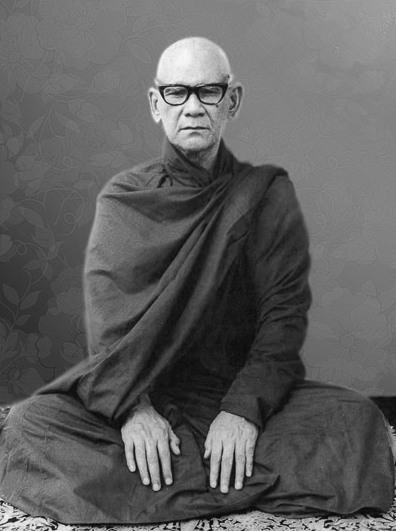
Mahasi Sayadaw

INTRODUCTION

On the personal request of the Hon’ble U Nu, Prime Minister, and Thado Thiri Thudhamma, Sir U Thwin, President of the Buddha Sasanna-nuggaha Association, the Ven’ble Mahasi Sayadaw, Bhadanta Sobhana Maha-thera, Sasana-dhaja-siri-pavara-dhammacariya, Agga-maha-pandita, Chattha-sangiti-pucchaka, came down from Shwebo to Rangoon on the 10th November 1949.  The Meditation centre at the Thathana Yeiktha, Hermitage Road, Rangoon, was formally opened on the 4th December 1949 when the Mahasi Sayadaw began to give 15 devotees a methodical training in the right system of Satipatthana Vipassana.

From the first day of the opening of the centre a discourse on the exposition of the Satipatthana Vipassana, its purpose, the method of practice, the benefits derived therefrom, etc., has been given daily to each batch of devotees arriving at the centre almost every day to undertake the intensive course of training  The discourse lasts usually for one hour and thirty minutes, and the task of talking almost daily in this manner had inevitably caused a strain.  Fortunately the Buddha Sasana-nuggaha Association came forward to relieve the situation with an offer of charity of a Tape-Recorder machine with which the  discourse given on the 27th July 1951 to a group of 15 devotees undertaking the training was taken on tape-record.  Thereafter this tape recorded discourse has been in constant use daily preceded by  a few preliminary remarks spoken by the Mahasi Sayadaw.

Then owing to the great demand of many Branch Meditation centres of the Mahasi Satipattana Vipassana as well as of the public, this discourse was published in the book form in 1954.  The book has how run to the sixth edition.  As there is also a keen interest and eager demand among many devotees of other nationalities who are unacquainted with Burmese the discourse is now translated into English.

U Pe Thin, (translator)
Mahasi Yogi

December, 1957

TRANSLATION

Namo Buddhassa.

Honour to the Fully Enlightened One.

On coming across the Sasana of Lord Buddha it is most important for every one to cultivate in oneself the virtues of  Sila, Samadhi and Panna.  One should, undoubtedly, possess these three virtues.

Sila is the observance, by lay-people, of five precepts as a minimum measure.  For Bhikkhus it is the discipline of Patimokkha Sila.  Any one who is well-disciplined in Sila would be re-born in the happy existence of human beings or devas.  But this ordinary form of Lokiya Sila would not be a safe-guard against the relapse into the lower states of miserable existence, such as, hell, or animals, or petas.  It is, therefore, desirable to cultivate the higher form of Lokuttara Sila as well.  This is Magga and Phala Sila.  When one has fully acquired the virtue of this Sila he is saved from the relapse into the lower states, and he will always lead a happy life by being re-born as human beings or devas.  Every one should, therefore, make it a point of his duty to work for the Lokuttara Sila.  There is every hope of success for any one who works sincerely and in real earnest.  It would indeed  be a pity if any one were to fail to take advantage of this fine chance of being endowed with the higher qualities, for he would undoubtedly be a victim sooner or later of his own bad karma which would pull him down to lower states of miserable existence of hell, or animals, or petas, where the span of life lasts many hundreds, thousands, or millions of millions of years.  It is therefore emphasised here that this coming across the Sasana of Lord Buddha is the very opportunity for working for the Magga Sila and Phala Sila.

It is not feasible to work for the Sila alone.  It is also necessary to practise Samadhi.  Samadhi is the fixed or tranquil state of mind.  The ordinary or undiciplined mind is in the habit of wandering to other places; it can not be kept under control; it follows any idea, thought or imagination, etc.  In order to prevent its wandering, the mind should be made to attend repeatedly to a selected object of Samadhi.  On gaining practice the mind gradually loosens its traits and remains fixed on the object to which it is directed.  This is Samadhi.  There are two forms of Samadhi, viz., Lokiya Samadhi and Lokuttara Samadhi.  Of these two, the practice in Samatha Bhavana viz: Anapana, Metta, Kasina, etc. will enable the development of the states of Lokiya Jhana, such as four Rupa-jjhahanas and four Arupa-jjhanas, by virtue of which one would be re-born in the plane of Brahama.  The life span of Brahma is very long and lasts for one world cycle, two, four, eight, up to a limit of eighty-four thousands of world-cycles as the case may be.  But at the end of the life-span a Brahama will die and be re-born as human being or deva.  If he leads a virtuous life all the time he may lead a happy life in higher existence.  But as he is not free from kilesas (defilements) he may commit demeritorious deeds on many occasions.  He will then be a victim of his bad karma and will be re-born in hell or other lower states of miserable existence.  This Lokiya Samadhi also is not a definite security.  It is desirable to work for the Lokuttara Samadhi, which is nothing but Magga Samadhi and Phala Samadhi.  To possess this Samadhi, it is essential to cultivate panna.